
JJ Gabriel & the Football Academy Problem Few Speak About
Manchester United academy prospect JJ Gabriel has become one of the biggest talking points in youth football after reports emerged that the teenager had asked to leave Manchester United and requested the cancellation of his registration.
For anybody involved in football academy development, however, the JJ Gabriel situation raises a much bigger question.
Are elite football academies sometimes progressing young players too quickly, not because it is the right developmental decision, but because it helps keep the player happy?
And if they are, could that short term decision actually create a much bigger problem later?
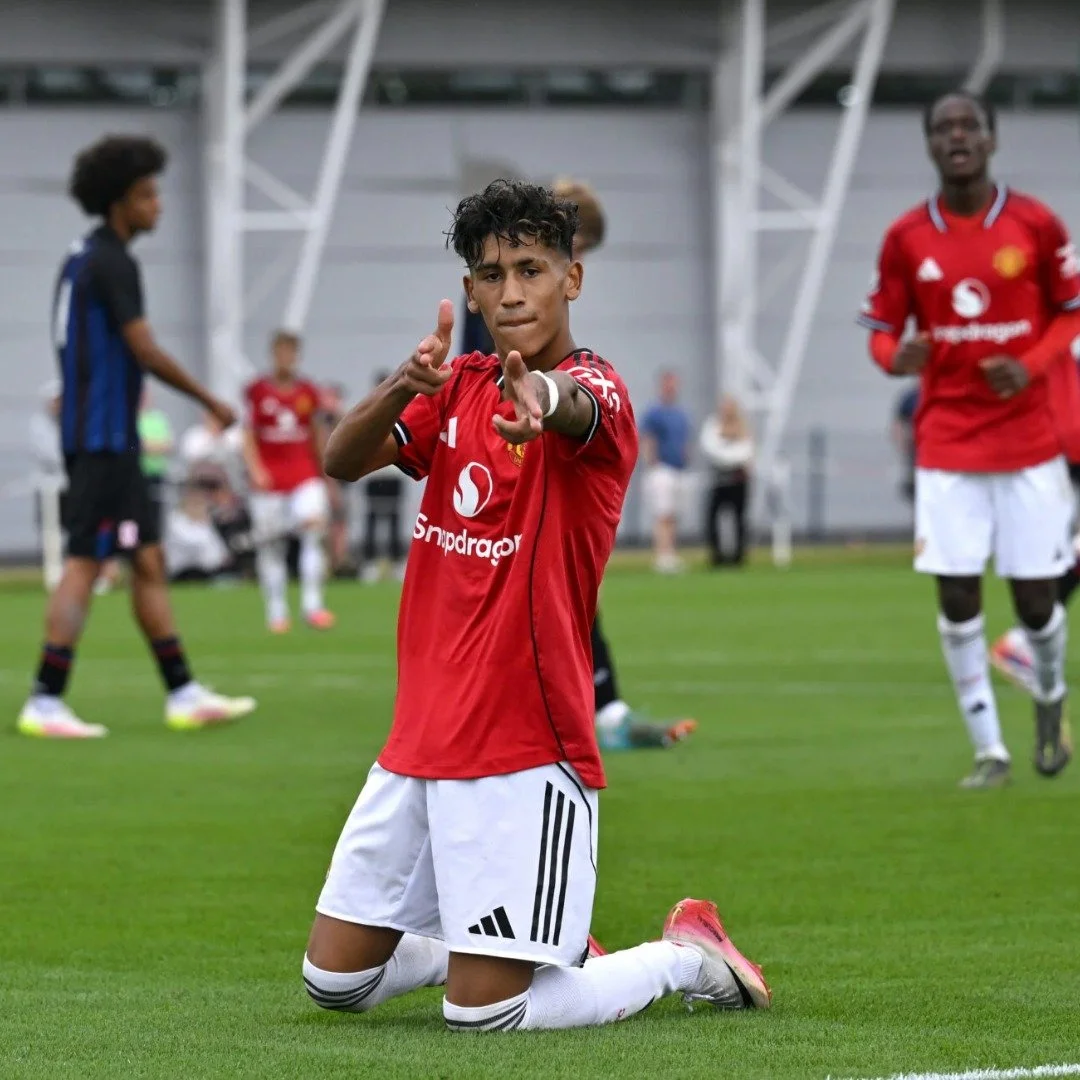
Who Is JJ Gabriel?
JJ Gabriel is one of the most highly rated young players to emerge from the Manchester United academy in recent years.
Born in October 2010, Gabriel is still only 15 at the time of writing. Yet he has already competed considerably above his chronological age.
During the 2025 and 2026 season, Gabriel scored 20 goals in 21 Under 18 Premier League appearances and was named the inaugural Under 18 Premier League Player of the Season. He was also named Manchester United's Jimmy Murphy Young Player of the Year.
Remember, this was a player competing at Under 18 level while still only 15.
His progression continued during the summer.
Gabriel trained around the Manchester United first team and made a senior appearance from the bench in a preseason friendly against Atletico Madrid. He subsequently featured for Manchester United's Under 21 side in Premier League 2 and also scored a hat trick in the UEFA Youth League.
Then came the surprise.
In September 2026, Sky Sports, The Guardian and other major outlets reported that Gabriel had requested to leave Manchester United, with his representatives asking for his registration to be cancelled.
It is important to make something clear before going any further.
We are not suggesting that playing above his age group is the reason JJ Gabriel wants to leave Manchester United. Nobody outside the player, his family and the club can confidently know every factor behind that decision.
But his situation provides an interesting case study for something we believe is becoming increasingly relevant across elite football academy environments.
What Does Playing Up Mean In A Football Academy?
Within professional football academies, talented players will regularly be given opportunities to train or play above their chronological age group.
Sometimes this is called playing up. Within coaching environments you might also hear people talk about stretching a player.
The principle is simple.
If the environment a player is currently experiencing is no longer challenging them sufficiently, you increase the difficulty of that environment.
A technically dominant Under 15 player might train with the Under 16s.
An Under 16 player who physically dominates his own age group might need exposure to Under 18 football.
An outstanding academy player might occasionally train with the first team.
There can be different reasons for doing this.
You might want to increase the speed of the game around the player.
You might want to test whether they can execute technically under greater pressure.
You might want to expose them to bigger and stronger opponents.
You might want to challenge their decision making.
You might want to see how they respond psychologically when they are no longer one of the best players on the pitch.
The important word in all of those examples is challenge.
Playing up should create a carefully selected developmental challenge.
Research into playing above age in academy football supports this broader view. The decision should consider technical, tactical, physical, psychological and social development rather than simply whether a player is talented enough to survive with older players.
That distinction matters.
When Development Becomes Retention
From experience within professional academy football, there appears to be another factor increasingly influencing these decisions.
Retention.
Elite academy football has become an extremely competitive marketplace.
Clubs are fighting to recruit the best players younger than ever. Agents and representatives are increasingly involved. Rival academies know who the outstanding players are. Families are aware of the interest around their child.
Suddenly, moving a player into an older age group can become more than a coaching decision.
It can become a message.
We believe in you.
You are ahead of everybody else.
You are part of our plans.
You are closer to the first team than other players your age.
In the short term, that can be incredibly powerful.
The player feels valued. The parents feel that progress is being made. The club demonstrates that there is a pathway.
But there is a potential problem.
What happens when you need to bring the player back down?

Once A Player Has Seen The First Team, Everything Changes
This is where the JJ Gabriel situation becomes particularly interesting from a football academy perspective.
Gabriel has already experienced Manchester United's senior environment.
He trained around the first team.
He appeared in a senior preseason fixture.
He has also played Under 21 football despite being only 15.
Manchester United's highest regular academy league side is now the Under 21s. Premier League 2 has been an Under 21 competition rather than an Under 23 competition since the 2022 and 2023 season. United also operate Under 18 and Under 19 teams for relevant competitions.
Think about that pathway from the player's perspective.
You have walked into the first team environment.
You have trained beside senior professionals.
You have experienced the speed of first team football.
You have been around the coaching staff.
You have put on the shirt in a senior fixture.
Then you return to academy football.
From a coaching perspective, there may be absolutely nothing wrong with that.
In fact, returning to the academy could be precisely what the player needs.
More touches.
More minutes.
More responsibility.
More opportunities to dominate games.
More time to develop physically.
More opportunities to work on weaknesses without the pressure surrounding senior football.
But the player does not necessarily experience that decision in the same way as the coach.
That is where expectation management becomes critical.

Progression Is Not Always A Straight Line
Young players need to understand one of the most important principles of elite development.
Progression is rarely linear.
Training with the first team on Tuesday does not mean you have permanently graduated from academy football by Wednesday.
Playing for the Under 21s does not mean playing for the Under 18s next month represents failure.
Sometimes the right development programme deliberately moves a player between environments.
One week the player might need the physical challenge of older opposition.
Another week they might need to become the main attacking influence within their own age group.
Sometimes they need to struggle.
Sometimes they need to dominate.
Sometimes they need to experience senior standards.
Sometimes they need 90 minutes of football.
These experiences are different tools within the same development programme.
The Premier League's own academy framework talks about giving players the right experiences at the right time and creating individual development plans based on the needs of each player.
That is what stretching a player should be about.
The problem begins when movement between age groups is presented, intentionally or otherwise, as promotion.
Because if going up becomes a promotion, going back automatically feels like a demotion.
Young Players Develop Expectations Very Quickly
We sometimes underestimate the psychology involved with elite young players.
These are highly competitive teenagers operating in an environment where everybody is constantly discussing progression.
Who is training up?
Who has been invited to the Under 21s?
Who trained with the first team?
Who got a squad number?
Who is the club talking about?
Who are other clubs interested in?
Players notice everything.
Parents notice everything.
Representatives certainly notice everything.
Once a player proves that they can survive in an older environment, the natural question becomes:
Why am I not there permanently?
That does not make a young player arrogant.
It makes expectation management an important part of academy coaching.
The Football Association itself recognises that adolescence involves significant psychological development alongside physical, technical and tactical development. Young players are developing their identity at exactly the same time as football is constantly giving them information about where they supposedly sit within a hierarchy.
That environment needs careful management.

Holding Your Own Is Not The Same As Being Ready
There is another important distinction within elite player development.
Being capable of surviving at a level does not necessarily mean that level is the best environment for your development every day.
A talented 15 year old may be capable of training with professional players.
That does not automatically mean they should permanently become a first team player.
Coaches have to look beyond whether the player can cope.
Can the player influence the session?
Can they reproduce their actions consistently?
Are they physically prepared for the training load?
Are they getting enough minutes?
Are they developing the areas of their game that require attention?
What happens when performances drop?
What happens when the novelty disappears?
What is the next challenge after this one?
These are development questions.
And they are much more important than simply saying that a player looked comfortable with older players.
The Short Term Reward Can Create A Long Term Problem
This is where football academies need to be careful.
Moving a player up can produce immediate satisfaction.
The player is happy.
The family is happy.
The club demonstrates a pathway.
Recruitment interest may temporarily disappear.
Everyone feels like the player is progressing.
But what expectation has just been created?
If the player believes that every upward movement is permanent, there is nowhere left to go except further upwards.
Under 16 becomes Under 18.
Under 18 becomes Under 21.
Under 21 becomes first team training.
First team training becomes first team squad.
First team squad becomes first team minutes.
Eventually the club reaches a point where the next progression cannot simply be manufactured.
Senior football has consequences.
Managers have jobs to protect.
Results matter.
Points matter.
Players are competing against established professionals.
At that stage, progression cannot simply be awarded because a talented academy player needs another psychological reward.
And that is when frustration can begin.
The Solution Is Not To Stop Playing Players Up
The answer is certainly not to stop challenging exceptional young players.
Playing above age can be hugely valuable.
Premier League academy structures are specifically designed to provide flexible development experiences, and research suggests that playing against older players can create useful technical, tactical, physical and psychological challenges when managed appropriately.
The solution is to be clearer about why it is happening.
Every time a football academy moves a player into an older environment, there should be a developmental reason behind it.
The player should know that reason.
The parents should know that reason.
And there should already be an understanding of what happens next.
Imagine the difference between these two messages.
You are training with the first team because you are now basically a first team player.
And this:
You are training with the first team for three weeks because we want to challenge the speed of your decision making. After that you will return to the Under 21s, where we want you starting matches and working specifically on your movement in the final third.
The physical experience might be identical.
Psychologically, they are completely different.
One creates status.
The other creates development.

Promote Players When They Are Ready To Stay
There is another approach academies should consider.
Before permanently progressing a player, ask whether they are genuinely ready to remain within that environment.
Short exposures are still valuable.
A session with the first team can be valuable.
A match with an older age group can be valuable.
Several weeks training up can be valuable.
But those experiences need to be clearly identified as developmental exposure rather than permanent promotion.
Permanent progression should ideally happen when there is a realistic possibility that the player can establish themselves at that level.
Otherwise the academy risks creating a ladder where the player is constantly looking at the next rung rather than concentrating on what they still need to learn.
The Real Football Academy Development Question
JJ Gabriel may ultimately stay at Manchester United.
He may leave.
His reasons may have nothing whatsoever to do with the developmental issue discussed here.
But his situation should encourage football academies to think carefully about how they manage exceptional talent.
The purpose of an academy is not to keep a player permanently satisfied.
It is to develop the player.
Sometimes development means giving them more.
Sometimes it means exposing them to older players.
Sometimes it means first team training.
But sometimes development means putting them back into an environment where they can play 90 minutes, make mistakes, dominate matches and continue learning.
The problem is not playing young players above their age.
The problem is doing it without a clear long term plan.
If playing up becomes primarily a recruitment tool, a retention tool or a way of reassuring players and parents that they are valued, academies should not be surprised when those same players eventually view returning to their natural development level as regression.
Football academy development has to be built around what the player needs tomorrow, not simply what keeps the player happy today.
That is the challenge.
And as competition for the best young footballers becomes more intense, it may become one of the biggest challenges facing the modern football academy.