
Marcelo Bielsa Training Philosophy
Marcelo Bielsa training is built on structure, repetition, and problem solving.
His coaching philosophy is simple in principle but extremely detailed in execution. He believes football must be taught through complete understanding of every movement that happens in a match.
Bielsa explains that talent alone is not enough. Players must learn how to solve the problems the game presents during competition.
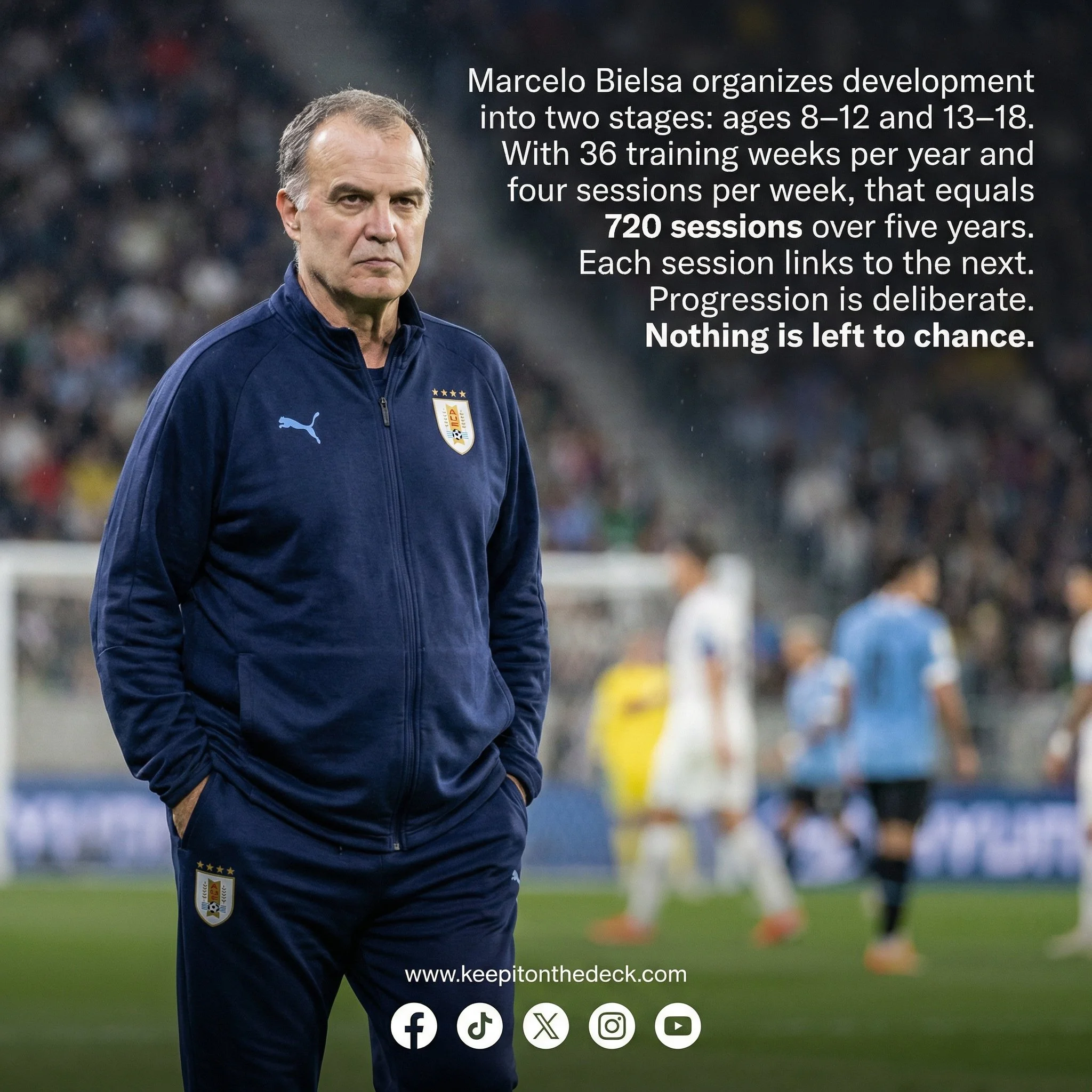
He divides development into two five year stages.
Ages eight to twelve
Ages thirteen to eighteen
Each year includes thirty six working weeks with four sessions per week. That produces seven hundred twenty structured training sessions in five years.
For Bielsa, every session must connect to the next. There must be clear progression from the first session to the final session. Nothing can be left untrained.
He created one hundred seventy exercises that represent the full game. He identified five ways to get free from a defender and twenty six movements required to receive the ball. Each movement has a specific training exercise.
Marcelo Bielsa coaching does not rely on random drills. It recreates real match situations. Sessions last no more than fifty minutes, with fifteen exercises performed at high intensity.
His philosophy is clear. A coach must not only identify problems but offer solutions. That belief defines Marcelo Bielsa training methods and explains why his coaching system continues to influence modern football worldwide.
Marcelo Bielsa Training Explained
Marcelo Bielsa Training Methods and Session Structure
Marcelo Bielsa training methods are built on precision, speed, and total game realism. Every session is carefully designed to reflect the exact demands of competition.
Bielsa limits training to around fifty minutes. Within that time, players complete approximately fifteen exercises performed at maximum focus and intensity. Each exercise lasts only a few minutes, forcing players to concentrate fully on every repetition. The objective is clear. Training must feel like a match.
His session structure is based on complete coverage of the game. He created one hundred seventy exercises to represent all technical and tactical situations a player may face. This includes five specific ways to create separation from a defender and twenty six different movements required to receive the ball correctly. Each movement is trained individually and then applied within realistic scenarios.
Marcelo Bielsa coaching does not separate technique from tactics. Every drill includes decision making. Players are not simply repeating actions. They are solving problems under pressure. This approach builds speed of thought as well as technical accuracy.
Ball circulation is central to his methodology. Sessions focus heavily on passing angles, body orientation, timing of movement, and breaking defensive lines. Players are taught to position themselves to receive the ball facing forward whenever possible. The objective is constant progression through intelligent positioning and precise execution.
Another defining element of Marcelo Bielsa training is progression. Every session connects to the previous one. Over years of development, players experience a complete football education where no situation is unfamiliar. This structured continuity is what separates Bielsa from traditional coaching models.
Marcelo Bielsa training methods are not random drills performed for fitness. They are deliberate rehearsals of match reality. That level of detail and structure explains why his coaching system continues to attract global attention from players, analysts, and elite coaches.

Marcelo Bielsa Coaching
Marcelo Bielsa Tactics and the Third Man Principle
Marcelo Bielsa tactics are built on intelligence, positioning, and constant attacking intention. His teams do not wait for space to appear. They create it through movement and precise passing.
One of the most important ideas in Marcelo Bielsa coaching is the third man principle. This concept focuses on the player who will receive the ball after the next pass. Instead of only supporting the ball carrier, players are trained to anticipate the next action before it happens. The third man arrives free because the defense is focused on the first two players involved in the exchange.
This tactical idea makes Bielsa teams extremely difficult to defend. The ball moves quickly between players, but the real danger comes from the runner or receiver who was not directly involved in the initial pass. By freeing that third player early, his teams break defensive lines and attack forward with speed.
Passing is central to this system. Marcelo Bielsa tactics demand angled passes that eliminate opponents rather than safe passes that slow the game. Players are instructed to circulate the ball centrally before attempting deeper progression. This draws opponents inward and opens channels for penetration.
He also emphasizes body orientation and visual awareness. A player must receive the ball prepared to play forward immediately. If the body is closed and facing backward, the attack loses speed and advantage. Every technical detail supports the tactical objective.
Marcelo Bielsa coaching does not encourage speculative football. His teams aim to dominate possession with purpose. The goal is not simply to keep the ball but to move it in ways that disorganize defensive structures.
The third man principle, rapid circulation, and line breaking passes define Marcelo Bielsa tactics. These ideas are why searches for Marcelo Bielsa tactical analysis and Marcelo Bielsa coaching philosophy continue to grow. His approach offers a clear blueprint for attacking modern defensive systems.

Marcelo Bielsa Coaching
Marcelo Bielsa on Passing and Technical Development
Marcelo Bielsa training places passing at the center of player development. He believes dribbling is natural and difficult to teach, but passing can and must be perfected through structured repetition.
In Marcelo Bielsa coaching sessions, players are trained to pass with purpose. The objective is not safe possession but progression. Every pass must eliminate opponents or shift defensive structure. Angles are critical. A player should rarely receive the ball with their back to goal because this slows the attack and limits vision.
Technical development in Marcelo Bielsa training begins with receiving the ball correctly. Body shape, first touch direction, and scanning before contact are non negotiable details. Players are taught to prepare their next action before the ball arrives. This creates speed without rushing.
He identified twenty six distinct movements required to receive the ball properly and built exercises around each one. This structured approach ensures that players are comfortable in every possible receiving situation. Over time, repetition builds automatic reactions that hold under pressure.
Ball circulation is another defining element. Marcelo Bielsa coaching demands quick central exchanges before attempting deeper passes. By moving the ball rapidly in tight areas, teams draw defenders out of position. Once space opens, the forward pass becomes decisive.
He also stresses the importance of ground passing. A precise pass that travels smoothly along the surface maintains tempo and control. This attention to detail reflects his belief that small technical improvements produce major tactical advantages.
Marcelo Bielsa training does not separate technique from tactics. Technical quality supports tactical clarity. Passing, receiving, and movement are not isolated skills but connected actions that define the identity of his teams.

Marcelo Bielsa Coaching
The Ten Commandments of Marcelo Bielsa Coaching
Marcelo Bielsa coaching is guided by clear principles that define his football identity. These ideas shape every training session, tactical decision, and player instruction.
One of Marcelo Bielsa strongest beliefs is that football must be played with beauty and attacking intent. Results matter, but performance and expression matter more. He believes supporters deserve football that inspires rather than football that simply protects a scoreline.
Marcelo Bielsa training emphasizes learning before automation. Players must understand movements deeply, then allow those movements to appear naturally during competition. Actions should not feel mechanical. They should emerge instinctively through understanding.
Another central idea in Marcelo Bielsa coaching is tactical completeness. Players must understand every major tactical system so that no situation feels unfamiliar. This prepares teams to adapt without losing structure.
He insists on angled passing to maintain vision and speed. When players receive the ball facing forward, they see more options and accelerate attacks. Body orientation and positioning are essential details within his methodology.
Bielsa also believes coaches must choose an identity. A team can attempt to dominate possession or wait and react. His preference is clear. He wants his teams to control the ball and dictate the rhythm of the match.
Solving problems in tight spaces is another pillar of Marcelo Bielsa training. Reducing space is easy. Learning to attack effectively when space is limited requires intelligence and preparation.
Finally, authenticity defines Marcelo Bielsa coaching philosophy. A coach must believe completely in his ideas. Conviction builds trust, and trust builds collective strength.

Marcelo Bielsa Training Study
Why Marcelo Bielsa Training Still Influences Modern Football
Many of today’s top coaches have adopted elements of Marcelo Bielsa coaching. High pressing, positional discipline, rapid ball circulation, and vertical progression are now common at elite levels. Bielsa applied these ideas years before they became widespread.
One reason Marcelo Bielsa training remains relevant is its focus on detail. Every movement is analyzed. Every pass has intention. Every session connects to a larger developmental plan. Players are not trained only for physical output. They are trained to think faster and position themselves intelligently.
His emphasis on structured repetition also explains his lasting impact. By designing one hundred seventy exercises that represent the entire game, Bielsa ensured that players experience complete tactical education. Over time, repetition produces clarity under pressure.
Marcelo Bielsa coaching also prioritizes attacking courage. His teams seek to dominate possession, break lines, and create numerical superiority through movement. This proactive approach has shaped the identity of many modern attacking systems.
Above all, Marcelo Bielsa training builds independent decision makers. Players are taught how to interpret space, read opponents, and anticipate actions before they unfold. That intellectual preparation gives his teams a competitive advantage.
For coaches searching for sustainable success, Marcelo Bielsa coaching methods offer a clear model. Structured development, tactical intelligence, and unwavering conviction define his legacy and ensure his continued influence on the global game.
For more About Marcelo Bielsa
Become a member of our site to get full access to the complete PDF that breaks down Marcelo Bielsa training methods and coaching philosophy in detail.